I wrote a procedure a long time ago (put_long_line ) as a substitute for DBMS_OUTPUT.put_line, the latter which had a 255-byte line limit before 10g. Put_long_line handles strings up to 32K, breaking them up into multiple lines on whitespace, including any delimiters you choose to include (commas, for example).
Several years later, I needed some way to dynamically generate and compile a very large PL/SQL package. The Oracle-supplied package DBMS_SQL has an array form of parse() so that you can have a PL/SQL block up to 2
32 lines, each 256 bytes long (matching the exposed package type DBMS_SQL.varchar2s, an index-by array of varchar2(256)). So I took put_long_line and retrofitted it to format a 32K string and populate an index-by array for parsing, instead of buffering it for printing.
This code uses the sample HR schema that comes with Oracle.
CREATE OR REPLACE PROCEDURE str2arr(
     p_source_string   IN VARCHAR2                      -- the source text string
     -------------------------------------------------------------------------
     -- p_output_array is the destination array, and is compatible with DBMS_SQL.parse
     --
     --   NOTE that DBMS_OUTPUT.put_line array has a 255 byte limit, but
     --   ---- DBMS_SQL.parse array has a 256 char limit.  We'll fix the line
     --        limit at 255 for compatibility reasons.
     -------------------------------------------------------------------------
    ,p_output_array   IN OUT NOCOPY DBMS_SQL.varchar2s
     -------------------------------------------------------------------------
     -- p_array_element is the array element to start writing to
     --
     --   NOTE when the array is partially filled (provided you started with
     --   ---- offset=0) you can use array.COUNT to pick up at the subsequent
     --        element.
     -------------------------------------------------------------------------
    ,p_array_element IN BINARY_INTEGER DEFAULT 0
     -------------------------------------------------------------------------
     -- p_line_length is the line limit, must be between 10 and 255 (the default)
     -------------------------------------------------------------------------
    ,p_line_length    IN NUMBER DEFAULT 255
     -------------------------------------------------------------------------
     -- p_whitespace is the set of delimiter chars to consider as whitespace
     --
     --   NOTE like put_long_line, actual whitespace (newline, space, tab) are
     --   ---- consumed when breaking up a line on a whitespace char, but any
     --        other char depicted as whitespace must actually be written.
     -------------------------------------------------------------------------
    ,p_whitespace   IN VARCHAR2 DEFAULT CHR(10)||CHR(9)||' ;,()=')
  IS
  ---------------------------------------------------------------------------
  -- Copy the contents of a string to an index-by array, in a manner similar
  --     to put_long_line.
  --
  -- Lines are normally broken up on embedded newlines.  If one is not found
  --     before the requested end of line, the line is broken up on the last
  --     whitespace character found (as identified by the set of delimiter
  --     characters.)
  ---------------------------------------------------------------------------

    c_newline CONSTANT VARCHAR2(1) := CHR(10);                 -- newline character (OS-independent)
    v_array_element BINARY_INTEGER := p_array_element;         -- used to increment array offset
    v_start_pos     INTEGER        := 1 ;                      -- start of string to print
    v_sub_end       INTEGER        ;                           -- end of substring to print
    v_str_end       INTEGER        := LENGTH(p_source_string); -- end of string to print
    v_newline_pos   INTEGER        ;                           -- point where newline found
    v_string_length INTEGER        := GREATEST(
                                               LEAST(p_line_length ,255 )
                                              , 10);           -- 10 <= len <= 255!

  BEGIN
    IF (v_str_end <= v_string_length) THEN  -- short enough to write in one chunk
      p_output_array(v_array_element) := p_source_string;
    ELSE  -- must break up string
        WHILE (v_start_pos <= v_str_end) LOOP
            v_newline_pos := INSTR(
                                     SUBSTR(p_source_string, v_start_pos, v_string_length)
                                   , c_newline
                                  )
                           + v_start_pos - 1;
            ------------------------------------------------------------------------
            IF (v_newline_pos >= v_start_pos) THEN  -- found a newline to break on
                p_output_array(v_array_element) := SUBSTR( p_source_string
                                                         , v_start_pos
                                                         , v_newline_pos-v_start_pos
                                                         );
                v_array_element := v_array_element + 1;  -- next array offset
                v_start_pos     := v_newline_pos   + 1;  -- skip past newline
            ELSE  -- no newline exists in chunk; look for whitespace
                -- next chunk not EOS
                v_sub_end := LEAST(v_start_pos+v_string_length-1, v_str_end);
                ---------------------------------------------------------------
                IF (v_sub_end < v_str_end) THEN  -- intermediate chunk
                    FOR i IN REVERSE v_start_pos .. v_sub_end LOOP
                        ------------------------------------------------------------------
                        IF (INSTR( p_whitespace
                                 , SUBSTR( p_source_string, i , 1)
                                 ) != 0) THEN
                            v_sub_end := i;  -- found suitable breaking point
                            EXIT;  -- break out of loop
                        END IF;
                        ------------------------------------------------------------------
                    END LOOP;  -- find breaking point
                ELSE  -- this is the last chunk
                    v_sub_end := v_sub_end + 1;  -- point just past EOS
                END IF;  -- last chunk?
                ---------------------------------------------------------------
                p_output_array(v_array_element) := SUBSTR( p_source_string
                                                         , v_start_pos
                                                         , v_sub_end-v_start_pos+1);
                v_array_element := v_array_element + 1;  -- next array offset
                v_start_pos     := v_sub_end       + 1;  -- next chunk
            END IF;  -- find newline to break on
            ------------------------------------------------------------------------
        END LOOP;  -- writing chunks
    END IF;  -- short enough or break up string?
END str2arr;
/
I added an offset parameter so that on multiple calls, I can pick up where I left off in the array and concatenate in new rows as needed.
So for example, I can generate a package containing collection types based on all the tables in the current schema:
Declare
    v_array  DBMS_SQL.varchar2s;  -- index-by array to hold generated code
    v_cursor integer;             -- cursor handle

Begin
    v_cursor := DBMS_SQL.open_cursor;  -- DBMS_SQL cursors are reusable

    --+------------------------------------------------------------------
    --| Write the first line of the code to be generated to the array
    --| passing the first 3 parameters, and defaulting on the line length
    --| and the values For whitespace.
    --+------------------------------------------------------------------
    str2arr( 'create or replace package typs is ' --p_source_string
            , v_array                             --p_output_array
            , 0);                                 --p_array_element

    --+------------------------------------------------------------------
    --| Write a line of code to the array For each table in User_Tables.
    --| Again, default on the line length and whitespace values.
    --+------------------------------------------------------------------
    For rec in (  select lower(table_name) table_name
                    from user_tables
                order by table_name)
    Loop
        str2arr( '  type typ_'   || rec.table_name ||
                 ' is table of ' || rec.table_name ||
                 '%rowtype;'                          --p_source_string
               , v_array                              --p_output_array
               , v_array.count);                      --p_array_element
    End Loop;

    --+------------------------------------------------------------------
    --| Write the last line of the code to generate to the array.
    --+------------------------------------------------------------------
    str2arr( 'End typs;'                              --p_source_string
           , v_array                                  --p_output_array
           , v_array.count);                          --p_array_element

    --+------------------------------------------------------------------
    --| Display contents of array
    --+------------------------------------------------------------------
    For i in 0..v_array.last Loop
        dbms_output.put_line(v_array(i));
    End Loop;

    --+------------------------------------------------------------------
    --| The act of parsing DDL creates the object
    --+------------------------------------------------------------------
    DBMS_SQL.parse( v_cursor        -- the cursor in which to parse the statement
                  , v_array         -- Sql statement to parse
                  , 0               -- lower bound for elements
                  , v_array.last    -- upper bound for elements
                  , true            -- line feed after each element
                  , DBMS_SQL.native -- normal behavior for the database
                  );
    DBMS_SQL.close_cursor(v_cursor);
End;
/
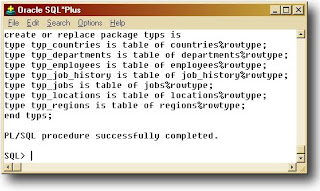
This transformation of an old utility into a new one took 15 minutes. I leveraged it for an entirely new purpose. You can recycle old code!
Click here to read the Oracle documentation about
DBMS_SQL
which allows the use of dynamic SQL to parse DML or DDL statements.


 Posts
Posts